Worklog Reports

Understanding Core Features

Logging Time


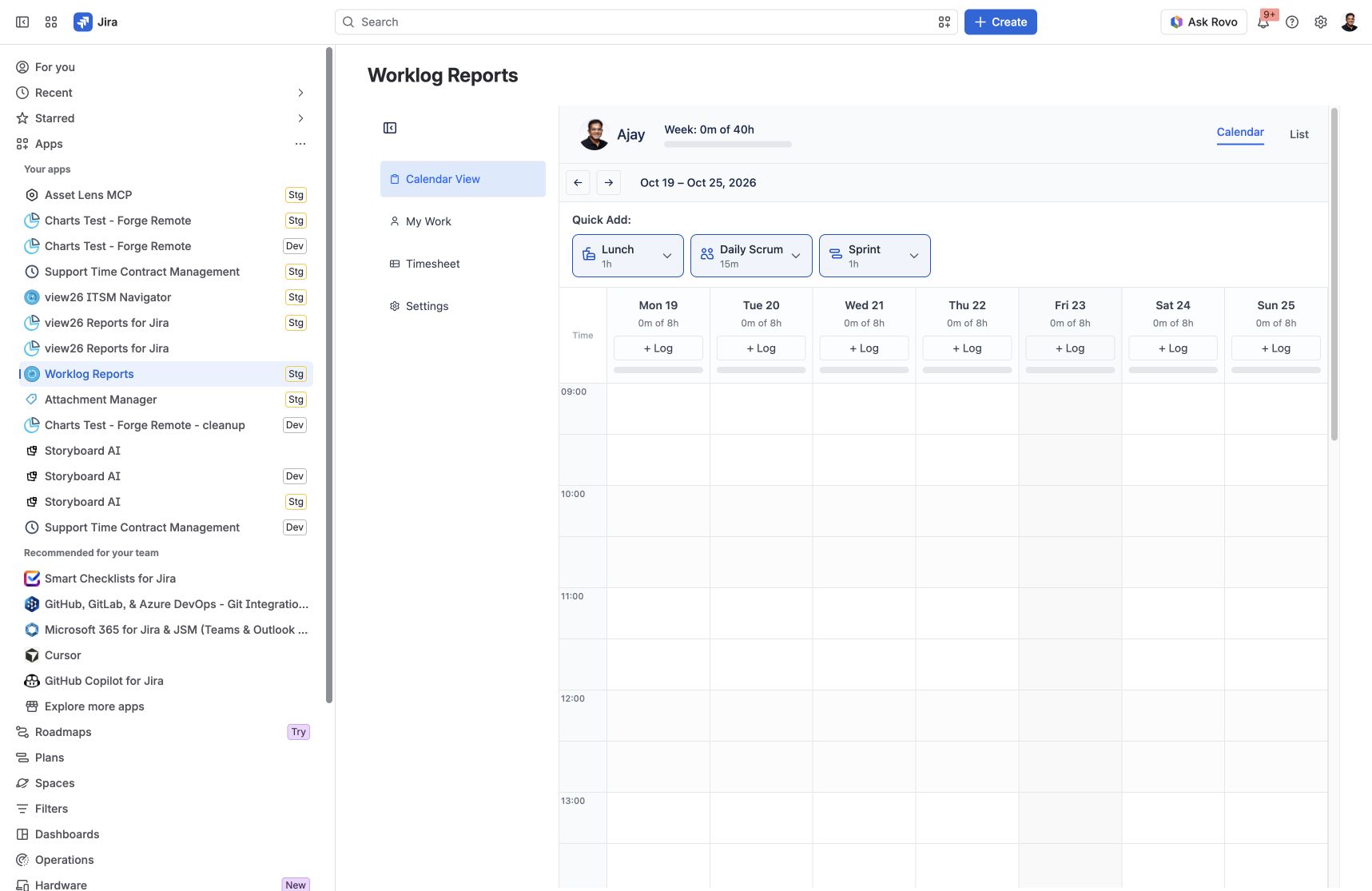
Method 1: From Calendar/List View

  1. Navigate to Calendar View from the sidebar

  2. Click on any time slot or on + Log button for the desired date and time

  3. The Log Work Form opens with pre-filled date and time

  4. Complete the form fields

  5. Click Log to save

image-20260408-091323.png

Method 2: From Dashboard

  1. Go to Dashboard

  2. Find the issue in Assigned Issues or Recent Issues

  3. Click on the issue

  4. The Log Work Form opens with the issue pre-selected

  5. Click Log to save

image-20260408-092006.png


Managing logged issues


image-20260408-091828.png


Editing Worklogs

  1. Click on any worklog card in Calendar or List view

  2. Click the Edit icon

  3. The Log Work Form opens with current values

  4. Click Update to save changes

  5. Changes sync to both the app and Jira

Deleting Worklogs

  1. Click on the worklog card

  2. Click the Delete icon

  3. Confirm deletion

Duplicating Worklogs

Calendar View supports quick duplication:

Duplicate Below (Column duplication):
  • Right-click or use duplicate button on a worklog

  • Select "Duplicate Below"

  • Creates identical entry immediately after the current one on the same day

Duplicate Right (Row duplication):
  • Select "Duplicate Right"

  • Creates identical entry the next day at the same time

Log Card Features


  • Drag and Drop: Move worklogs to different times

  • Resize: Drag the bottom edge to adjust duration (30-min snap)

  • Color Coding: Different colors per category

  • Hover Actions: Actions appear on hover

Dashboard Features


Overview

The Dashboard provides an at-a-glance summary of your work activity, quick access to issues, and shortcuts for logging time.

1. Weekly Overview

  • Week Total: Sum of hours for current week (Monday-Sunday)

  • Progress Bar: Visual indicator toward 40-hour week

  • User Info: Your name header

  • Today's Hours: Total hours logged today

  • Real-time Updates: Updates as you log work

2. Assigned Issues

Shows all Jira issues currently assigned to you:

  • Issue Key: Clickable link to navigate to Jira

  • Quick Log: Click any issue to open Log Work Form with issue pre-selected

3. Recent Issues

Displays issues updated recently:

  • Recently Updated: Issues with recent activity

  • Quick Access: Click to log time


image-20251017-074357.png


Advanced search using Jira Query Language in “Recents” tab:

Example JQL Queries:

project = MYPROJ AND status = "Open" AND
assignee = currentUser() AND updated >= -7d 

How to Use:

  1. Enter JQL query in the search box

  2. Press Enter or click Search

  3. Results display below with issue keys and summaries

  4. Click any result to log work

Dashboard Best Practices

  • Start of Day: Check assigned issues to plan your day

  • End of Day: Verify you've logged all work in Today's Logs

  • Weekly Check-in: Review weekly total

  • Quick Logging: Use Recent Issues for follow-up work on same issues

Timesheet View


Overview

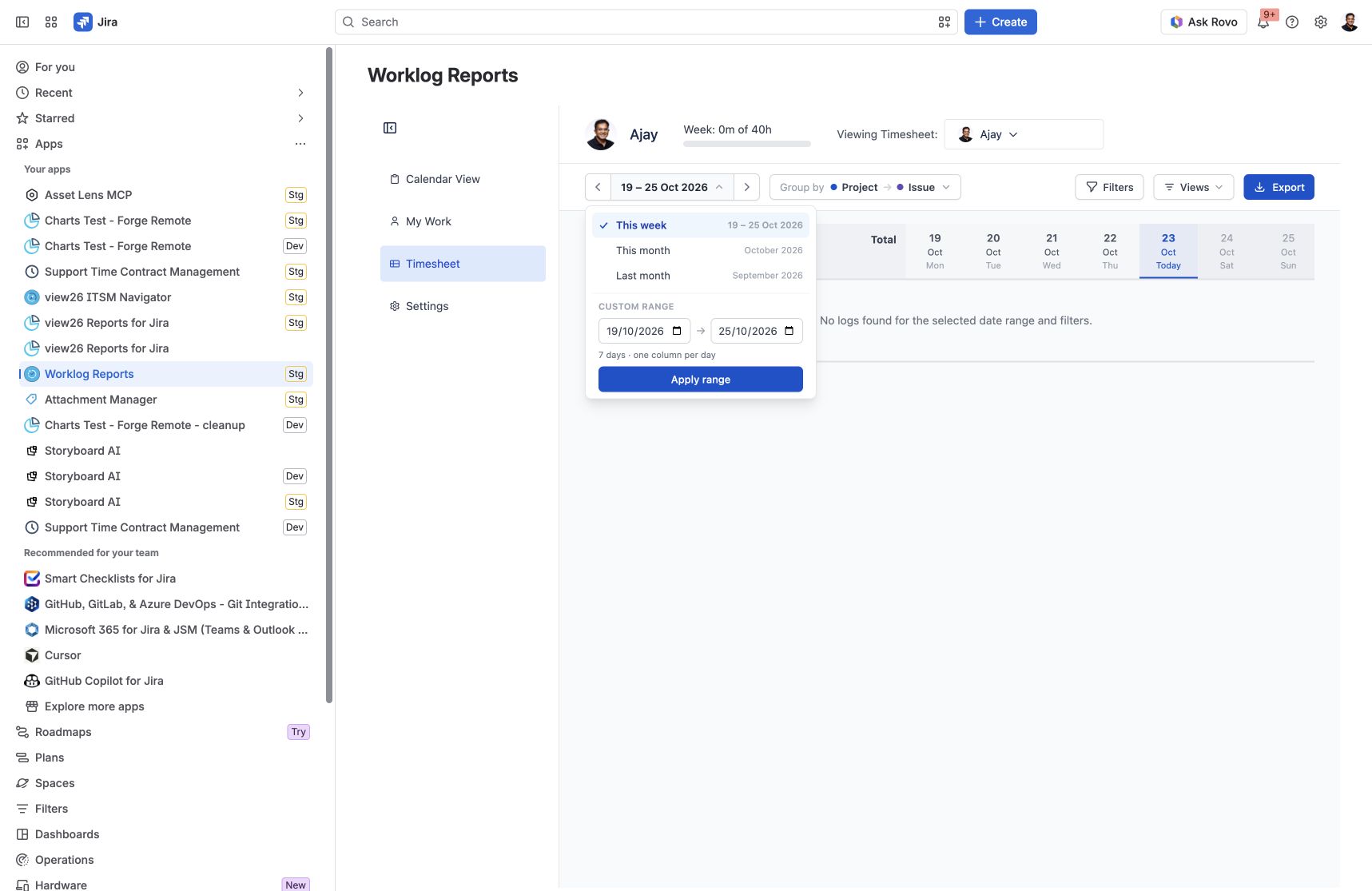
The Timesheet View presents your work in a traditional timesheet table format, organized by date columns and task rows. It supports filtering and multiple date range views.

Timesheet Layouts

Weekly View (Default)

  • Columns: Monday through Sunday

  • Rows: Grouped by Project → Issue → Category/Subcategory

  • Totals: Daily and weekly totals calculated automatically

Extended Views

  • Last 30 Days: Detailed list of all logs from past month

  • Last 60 Days: Detailed list of all logs from past 2 months

Billable Tracking

  • Billable hours are indicated with a blue $ sign next to the logged hours in the timesheet table

  • Total Hours row shows a breakdown: Billable hours (blue) and Non-billable hours (gray)

image-20260408-100841.png
image-20260408-100950.png


Generating Reports


Report Configuration

1. Date Range Selection

Choose your report time period: This Week, Last Week, Last 30/60 days

2. Filter Selection

Available Filters:

  • Users Selection:

    • Viewing Timesheet dropdown — select one or multiple team members to view their timesheets (requires View All Worklogs or Edit All Worklogs permission)

    • Regular users see only their own data

  • Categories: Select specific work types (multi-select)

  • Subcategories: Filter by subcategories based on the selected categories

  • Projects: Include specific Jira projects (searchable multi-select)

All filters apply to both the on-screen table view and exported reports.

3. PDF Export

What's Included:

  • Report title with date range

  • Filter summary (categories, projects, assignees selected)

  • Aggregation tables with totals

  • Total hours and statistics

  • Generation timestamp

4. Excel Export

Click Export → Export as Excel to generate a styled .xlsx file.

Weekly View generates two sheets:

Sheet 1 — Weekly Report:

  • Summary section: date range, assignee(s), total hours, billable hours, non-billable hours, generation timestamp

  • Data grouped by Project → Assignee (when multiple users selected)

  • Billable status per issue

  • Styled with color-coded headers, project rows, user rows, and alternating data rows

Sheet 2 — Detailed Logs:

  • Individual worklog entries

  • Grouped by assignee with total hours per assignee

  • Shows the actual worklog description entered by the user

30/60 Day View generates one sheet:

  • Summary section: date range, assignee(s), total hours, billable hours, non-billable hours, generation timestampIndividual log entries grouped by assignee

  • Billable status per entry

Formulas: Sum formulas for easy manipulation

image-20260408-095332.png
image-20260408-095420.png


Settings - Category Management & Preferences


Admin Access Only

Manage work categories and subcategories for organizing time logs across your team.

Requirements:

  • Jira Administrator permissions required

  • Access: Click Settings in sidebar (only visible to admins)

Access Denied? Contact your Jira admin to grant "Administer Jira" permission.

1. Categories

Top-level classifications for work types (e.g., Development, Testing, Design, Meeting).

image-20260408-094159.png

Add Category

  1. Enter category name in input field

  2. Click "Add Category"

  3. Category appears immediately, available for all users

image-20251107-090100.png

Edit Category

  1. Click Edit icon next to category

  2. Modify name in text field

  3. Click green checkmark to save

  4. Click X to cancel

image-20251107-090220.png


Delete Category

  1. Click Delete icon (trash) next to category

  2. Confirm deletion

⚠️ Warning:

  • Deletes all subcategories under this category

  • Permanent - cannot be undone

  • Existing worklogs keep the category name for historical records

image-20251107-090305.png


2. Subcategories

image-20251107-090356.png


Add Subcategory

  • Select parent category from dropdown

  • Enter subcategory name in input field

  • Click "Add Subcategory" or press Enter

  • Subcategory appears under parent category

Edit Subcategory

  • Click Edit icon next to subcategory name

  • Modify name in text field

  • Click green checkmark to save or press Enter

  • Click X to cancel or press Escape

Delete Subcategory

  • Click Delete icon next to subcategory name

  • Confirm deletion

  • ⚠️ Warning: Permanent deletion (cannot be undone)

3. User Preferences

Configure your personal working hours and daily targets from Settings → Preferences.

Calendar Time Range
Set the start and end time for your calendar grid.

  • Default: 9:00 AM to Midnight

  • Example: Set 10:00 AM to 7:00 PM for a standard workday

Daily Target Hours
Set your daily work target used for the progress bar on the calendar header. Each day column shows progress toward this target with color indicators.

  • Default: 8 hours per day

  • Green: near or at target

  • Yellow: partially complete

  • Red: below target

  • Blue with overtime label: exceeded target

image-20260408-102417.png